Colour Consistency Across Batches: Specifying LED Profiles That Match
Abstract: Colour is the defect buyers notice and suppliers argue about, because “slightly different” is not a specification either side can enforce. This article sets out where batch-to-batch drift in extruded lighting profiles actually comes from (raw material lots, masterbatch dispersion, thermal history, cooling and die deposits), why long linear runs expose it, and how to turn it into something measurable. It covers what a colour tolerance in numbers is really asking for, why a physical limit sample beats a written description, what process monitoring does to hold it, and the clauses and incoming checks that stop the argument before it starts. Inspection and traceability references come from the Baoming workshop pages.
Why two batches of the same profile can look different
A re-order is supposed to be the easy part. The drawing is frozen, the die already exists, and the material is on the spec. Then the second delivery arrives, somebody holds a piece next to a leftover from the first, and the two are not the same colour.
This is not usually a mistake. Extrusion colour varies for reasons that are inherent to the process, and the size of the variation depends on how tightly the inputs are controlled. What turns it into a dispute is that neither the drawing nor the purchase order said how much variation was acceptable, so both parties are arguing from memory instead of from a number.
The fix is not exotic. It is to decide, before the first order, what “the same colour” means in terms you can measure on a delivered part.
Where the difference actually comes from
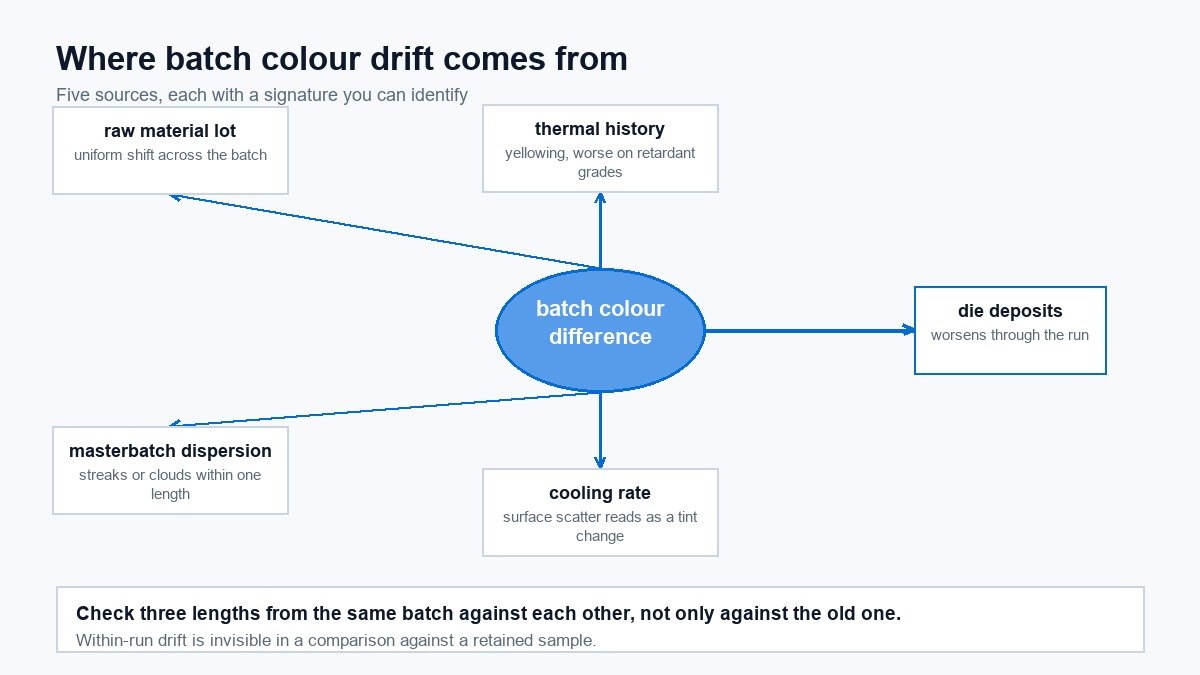
Five sources account for most of it, and they behave differently.
Raw material lot changes. Polymer is made in batches, and natural resin carries a slight tint variation between lots even when it meets the same grade specification. On optical grades that variation is small, but a diffuser is a thin translucent section lit from behind, so small reads as visible.
Masterbatch and dispersion. Colour in an extruded profile usually comes from a masterbatch, which is a concentrated pigment carrier dosed into the natural resin. Two things go wrong here. The dose can vary, and the pigment can disperse unevenly. Poor dispersion does not just shift the hue, it produces streaks and clouds within a single length, which is worse than a uniform shift because it cannot be matched by adjusting anything downstream.
Thermal history. The polymer is held molten at temperature for a period before it reaches the die. Too hot, or too long, and the material degrades slightly, and thermal degradation shows up first as yellowing. The mechanisms behind yellowing in service are the same ones that show up early when a run is processed too hot. Flame retardant compounds are more sensitive to this than optical grades, which is worth knowing if your profile carries a fire rating.
Cooling rate. Cooling sets the surface structure, and surface structure affects how light scatters. A profile that comes off the line slightly cooler or slightly faster can read as a different shade even when the chemistry is identical, because what you see is partly a surface effect rather than a bulk colour effect.
Die deposits. Over a long run, material can build up at the die lip. This is one reason the condition of the die through its working life is worth tracking rather than assuming stays constant. The deposit changes the surface finish of the profile as it forms, and a surface finish change reads as a colour change. This one has a distinctive signature: it gets worse through a run rather than appearing all at once, which makes it identifiable from inspection records.
Linear runs make it obvious
A single short cover in a housing can hide a surprising amount of drift, because nothing nearby gives the eye a reference. Linear lighting is unforgiving in a way that point fixtures are not.
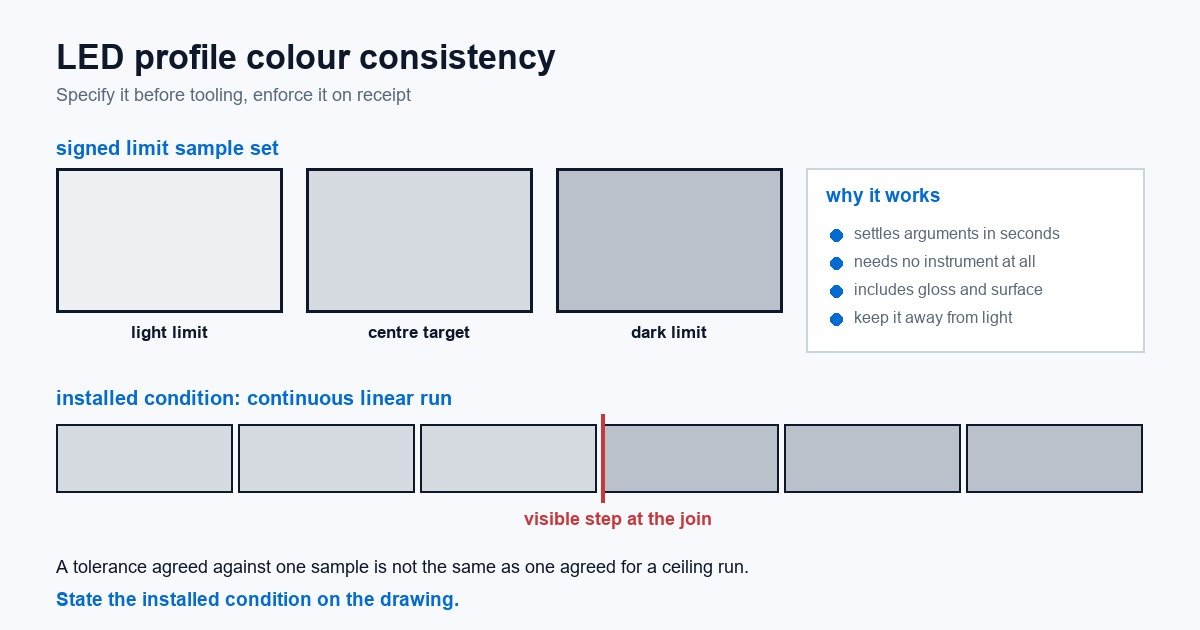
Put twenty metres of profile on a ceiling in continuous runs and the eye has a long reference right next to the piece being judged. Two lengths with a small difference becomes a visible step at the join. Add the fact that long runs are often installed over weeks, mixing deliveries, and the tolerance that mattered in the sample approval stage turns out to be tighter than anything anyone wrote down.
This is why the specification should be written for the installed condition, not for the sample. If the product is a continuous linear run, say so on the drawing, and treat batch matching as a requirement rather than a courtesy. Linear profile manufacturing has its own length and straightness tolerances, and colour matching belongs alongside them on the same drawing.
Describing colour without adjectives
“White”, “opal” and “neutral” are adjectives, and adjectives cannot be enforced. Two usable substitutes exist, and the good specifications use both.
Numbers. Colour can be expressed as coordinates in a defined colour space, and the difference between two samples as a single distance value in that space. That gives you a tolerance you can write as a number and measure with an instrument. Two cautions. The value is meaningless without the measurement conditions (illuminant, observer angle, whether the sample is measured in transmission or in reflection), so state them. And a number by itself does not tell you which direction the drift went, so it is worth naming the coordinates as well as the distance.
Physical limit samples. A pair of physical samples, one at the light end of what you will accept and one at the dark end, is the most practical specification there is. It settles arguments in seconds, it needs no instrument, and it captures appearance in a way a single number does not, because it includes surface and gloss.
The strongest specification is a number with a physical pair of limits behind it. The number makes it enforceable at a supplier’s incoming inspection, and the samples make it enforceable on a factory floor without a spectrophotometer.
Limit samples: the cheapest specification you can write
The procedure is simple enough that it is worth describing exactly, because it is usually done informally and that is where it fails.
At first article approval, ask for three pieces: a centre sample at the target, plus one at each end of the acceptable range. Sign and date all three. Keep one set and send one set back. Reference the set in the purchase order, so a re-order says “to match limit sample set dated X” rather than “same as last time”.
Two details make the difference between a limit sample that works and one that does not. Keep the samples away from light and heat, because they will drift themselves and then authorise the wrong product. And agree the viewing conditions, meaning which light source and whether the comparison is done lit from behind or in reflected light, since a diffuser judged in reflected room light and the same diffuser lit from behind are not the same comparison at all.
What the process does to hold it
Consistency is not only a specification problem. Some of it is decided by how the line is watched, and this is the part worth asking a supplier about directly.
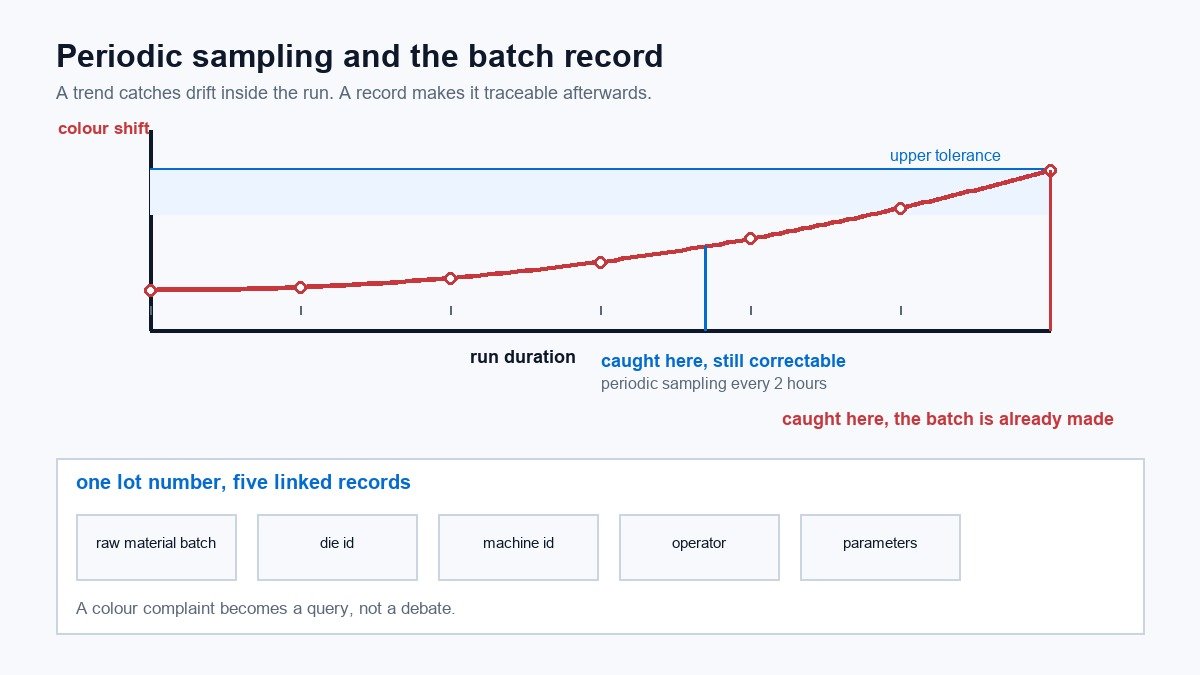
The relevant practice is periodic measurement during a run rather than only at the start and end. Sampling on a fixed interval, covering dimensions, thickness, transmission and surface, produces a trend rather than a pass or fail, and a trend shows drift while it is still small enough to correct within the same run. An end-of-run check tells you the batch is wrong after it has been made.
The second half is records. When a lot carries a single identifier that links the raw material batch, the die used, the machine, the operator and the process parameters, a colour complaint becomes a search rather than a debate. That batch traceability structure is what turns a dispute about shade into a query about one run. Without that link, the only available answer is a shrug and a replacement, which costs the same and teaches nobody anything.
Worth asking whether the inspection records for a delivered lot can be provided with it. A supplier with a working record system will say yes without hesitation.
Texture changes how much drift you can see
Surface finish is not neutral on this question. A gloss surface reflects, and reflection amplifies small differences in tint because the viewer sees the material and the room at once. A matte or finely textured surface scatters, and scattering masks a surprising amount of underlying variation.
That gives a practical lever. If a project is struggling to hold a tight colour tolerance on a gloss profile, moving to a fine texture can make the same material variation invisible, which is often cheaper than tightening the colour specification itself.
It works the other way too. A prismatic or micro-structured surface has optical geometry that is sensitive to formation, so on those finishes the process control matters more, not less. Texture is a variable here, not a blanket fix, and it is worth saying which finish the tolerance was agreed against.
Five clauses and three incoming checks
Clauses worth writing in:
- A colour tolerance in numbers, with the measurement conditions stated (illuminant, observer, transmission or reflection).
- A signed limit sample set, dated, referenced in the purchase order, with agreed viewing conditions.
- A requirement that re-orders match the limit set, not “previous delivery”.
- Inspection records for the delivered lot, available with the shipment.
- A batch identifier on the packing, linking to material and process records.
Checks worth doing on receipt, all cheap:
- Hold a new length against the retained limit sample in the agreed light. This catches nearly everything that matters and takes seconds.
- Compare three lengths from the same batch against each other, not just against the old one. This is what catches within-run drift from die deposits, which a comparison against an old sample will not reveal.
- Check the ends against the middle of a length. Uneven pigment dispersion tends to show up along the extrusion direction, and it is easier to see at this stage than after installation.
Retain a piece from every delivery, labelled with its batch identifier. The cost is a shelf, and the value shows up the first time there is a dispute.
Where this leaves the next order
Colour drift is not a defect in the sense that a wrong dimension is a defect. It is variation, and the only question is whether the variation is inside a limit anyone agreed. Agreements made after delivery are arguments. Agreements made before tooling are specifications.
Write the tolerance, sign the samples, ask for the records, and put the batch number on the box. If you need numbers for dimensional tolerances as well as colour, put them in the same specification block so nothing gets renegotiated later.
Bringing a re-order back to match an existing installation? Send the limit sample reference and the batch number with the enquiry and the match can be checked before production starts.
Setting a ΔE target that can actually be checked
“Match the previous batch” is not a specification. A colour-difference number is — but only with three things attached to it: what it is measured against, where on the section it is measured, and who keeps the reference. Without those, a ΔE figure is decoration.
| Element of the clause | What to write | Why the clause fails without it |
|---|---|---|
| The reference | A retained physical sample from the approved first article, held by both sides, with a date. | A number with nothing to measure against cannot be tested. This is the most common gap. |
| The measurement position | Where on the section the reading is taken: the light-exit face, a flat, or a marked area — and whether it is taken lit or unlit. | An optical diffuser reads differently depending on whether light passes through it. Two labs can disagree purely on position. |
| The illuminant and geometry | Which standard illuminant and observer, and whether specular component is included. | ΔE is method-dependent. Same sample, two methods, two answers. |
| The limit and the tolerance band | A numeric limit, stated as a maximum, plus what happens at the boundary — accept, accept with note, or reject. | “As close as possible” leaves the decision with whoever is holding the invoice. |
| The interval | When it is measured: at first article, per batch, per production run, or per colour lot. | A clause with no interval is measured once and then forgotten. |

Four ways a colour clause collapses
What to put on the drawing
- Colour reference — a RAL or Pantone code, plus whether a physical master sample must be lodged with the supplier.
- ΔE limit, stated as a maximum against the retained reference.
- Measurement position and method, including lit or unlit.
- Interval — first article, per batch, or per run.
- Batch documentation required, so a reading can be tied back to a production lot.
Related reading: why diffusers yellow and how to specify against it, PC vs PMMA selection matrix, and choosing a material for LED diffusers.