Extrusion Die Lifecycle: What In-House Tooling Actually Buys You
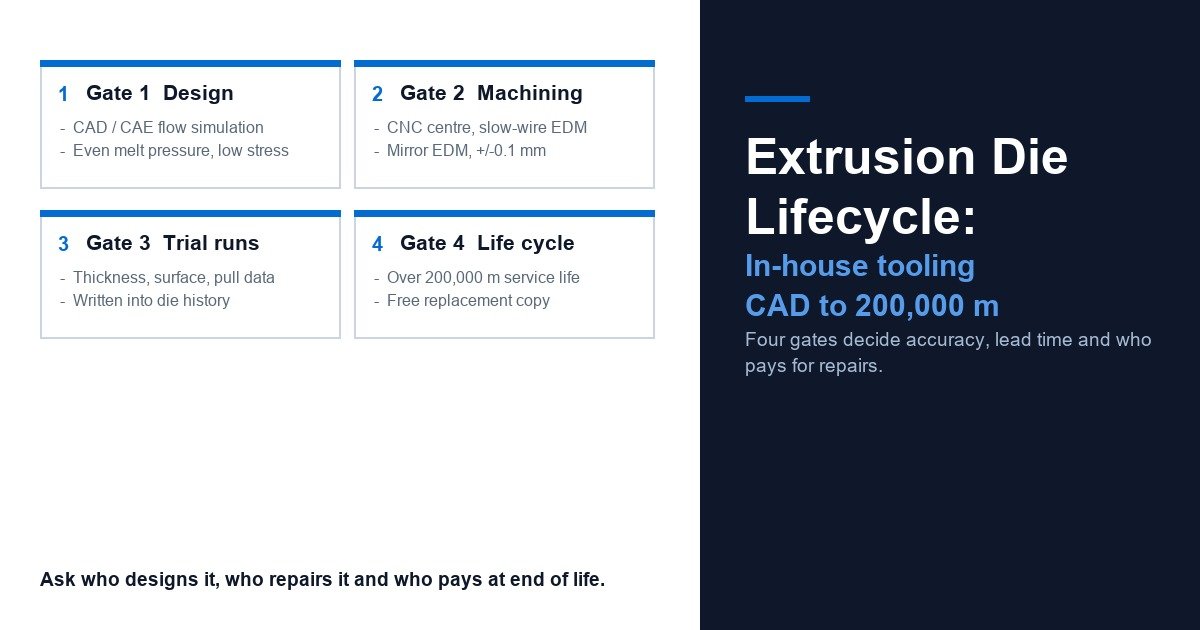
Abstract: Most quotes say simply “tooling included”. They rarely say who designs the die, who machines it, how long it lasts, or who pays when it wears out. Those four questions decide far more than the tooling fee itself. Working down the four gates of an in-house die shop (CAD/CAE flow simulation, precision machining, instrumented trial runs, lifecycle management), this article shows what each gate is worth at the buying end, why die history beats a lucky first shot, and which three long-term clauses belong in the technical agreement. Equipment and capability figures quoted here come from the Baoming workshop pages.
Who makes the die matters more than what it costs
A tooling line item on a quotation usually arrives without a qualifier. What that money buys may be a die designed, cut and maintained in the extruder’s own shop, or a drawing handed to a third-party toolmaker. The difference is invisible on the first article and obvious around year three, when you need someone to repair it.
In-house tooling is worth having because it closes the loop. Design, machining, trials, repair and end-of-life replication all sit with the same party, so a dimensional drift does not turn into a blame exchange between two companies.
Gate 1: design, what CAD/CAE flow simulation predicts
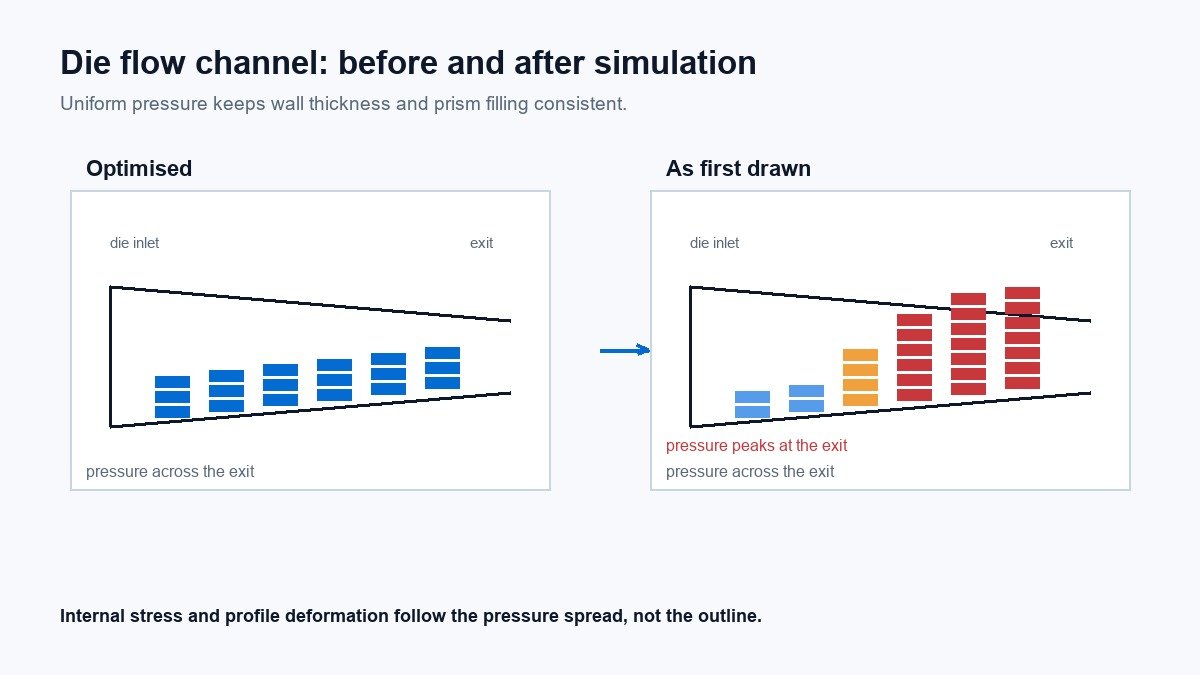
Die design is not drawing the profile outline. What matters is how melt behaves on the way to the exit: whether pressure is evenly distributed and whether flow velocity is consistent across the section. That decides internal stress and whether the profile comes out straight.
The die centre described here uses professional design packages (AutoCAD, SolidWorks and Moldflow are named) for 3D modelling and melt flow analysis, specifically to optimise flow channel geometry so that pressure stays uniform.
There is only one verifiable move available to a buyer at this gate: ask for the simulation conclusion, not a screenshot. A useful answer states which risks were found and what geometry was changed to resolve them. “We run Moldflow” is not an answer.
Gate 2: machining, the equipment behind the tolerance claim
The published equipment list is CNC machining centres, slow-wire EDM and mirror EDM. Those three cover roughly separable jobs: rough and finish cutting of the flow surfaces, narrow slots and sharp corners, and optical-grade mirror finishing.
The stated tolerance for critical dimensions is ±0.1 mm. It earns its weight when it sits in the technical agreement and is then checked against the first-article full-dimension report, so that the claimed tolerance and the measurement method are talking about the same thing.
Gate 3: trial runs, ask for the die history
Trials run on the supplier’s own extrusion lines, with thickness, surface quality and haul-off stability captured while the line is running. Findings are filed and the corrective action is written into the die’s own record.
The operative word is “record”. A first shot that lands on size is not remarkable. What matters is whether the second and third corrections can be reconstructed: what was changed, when, and why. You can turn that into a purchasing requirement quite easily: the die history ships with the first production batch.
Gate 4: lifecycle, what happens after 200,000 m
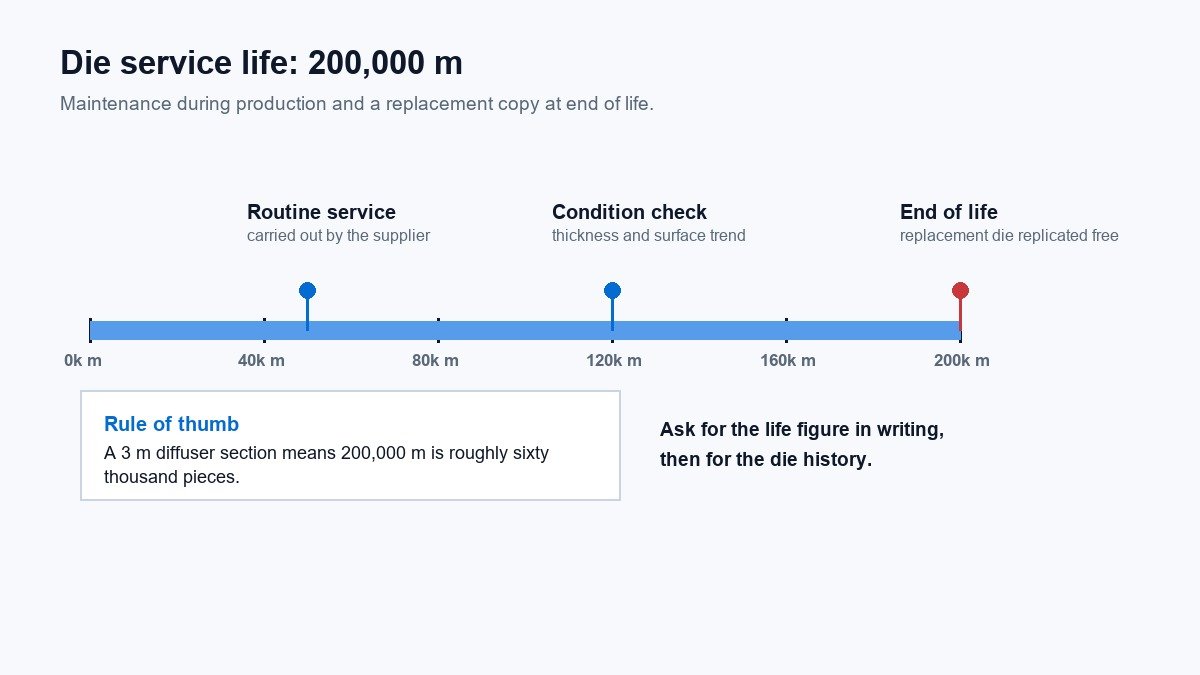
Service life is stated as 200,000 m or more under normal operating conditions. For scale, a 3 m linear diffuser section means 200,000 m is roughly sixty thousand pieces. Tooling is not a consumable, and it is not permanent either.
Two commitments sit at the end of that life, and both are unusual enough to quote directly: when the die reaches end of life it is replicated free of charge, and during the extrusion service period routine maintenance, servicing and repairs are carried out by the supplier.
Those two sentences change what the tooling fee is. It stops being the purchase of a physical object and becomes the purchase of continued capacity.
Three clauses that usually get left out
| Clause | Typical wording | Wording worth having |
|---|---|---|
| Life and replacement | not stated | stated life figure (e.g. 200,000 m) plus who pays for the replacement die |
| Maintenance ownership | not stated | who maintains and repairs the die during production, and at whose cost |
| Texture and material scope | “per sample” | the actual list of achievable textures and eligible materials |
Texture and material range
Tooling capability shows up as what it can produce. The published range runs like this:
- More than ten finishes: mirror polish, matte, diamond embossing, linear grooves, V-grooves; process side also lists embossing, matte, glossy and frosted;
- Optical structures: anti-glare (UGR below 19), prismatic patterns, micro-embossing;
- Safety-related structures: V0 flame-retardant covers for passenger compartments and train lighting;
- Materials: PMMA, PC and co-extruded compounds;
- Profile families: standard and custom linear covers (T5, T8, U-shape, irregular), large troffer covers, special optical components.
So “can you make it” is rarely a question about the extruder. It is a question about whether the texture and structure already exist in the die library. Asking for finish samples alongside the corresponding die list tells you more than any brochure. If you are still weighing the profile geometry itself, how to develop a custom LED diffuser profile covers the drawing side, and linear diffuser selection and UGR covers what those textures do to glare.
Four questions for the next RFQ
- Who designs and machines the die, and is any of it subcontracted to another tool shop?
- Will trial data (thickness, surface, pull stability) and the die history be delivered with the first batch?
- What is the stated service life, and who pays for the replacement die at end of life?
- Who handles maintenance, servicing and repair during production, and is it inside the conversion price or billed separately?
Where this leaves the tooling negotiation
Tooling price differences are usually not differences in machining cost. They are differences in where responsibility stops. Writing life, replacement and maintenance into the agreement is worth more than shaving five percent off the fee, particularly on small-batch, multi-profile programmes where changeover scrap and waiting on repairs are the two biggest items in the schedule.
We build custom linear diffuser profiles and troffer frame extrusions on tooling we design and maintain ourselves. Tolerance targets are discussed before the die is cut rather than after the first article arrives; see LED profile extrusion tolerance for how that conversation goes. Browse the full optical range or request a quote with your drawing attached.
What happens to the die between orders
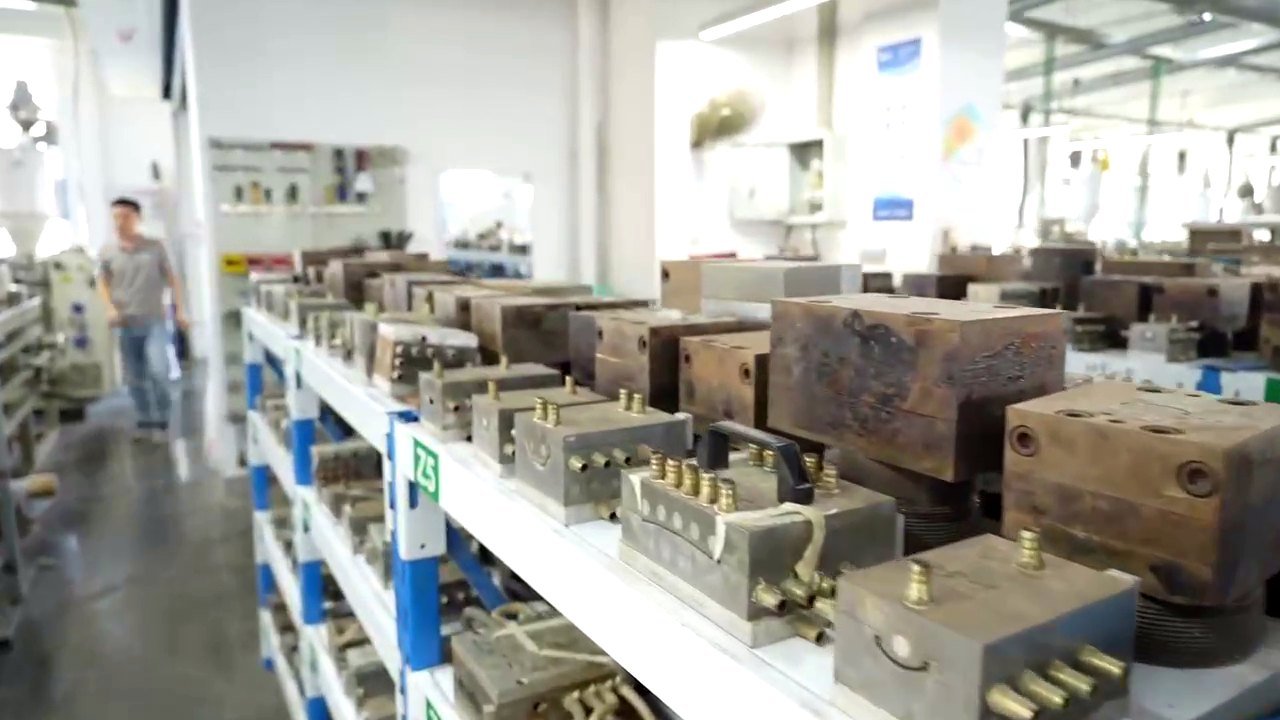
The tooling charge is the start of the die’s life, not the end of it. A die is pulled, cleaned, measured, re-polished and re-fitted as it wears, and eventually retired. Which of those events you pay for, and who owns the steel while it sits on a shelf, is a contract question — and it is the question that decides whether a repeat order in year three is a formality or a negotiation.
| Stage | What happens | What to get in writing |
|---|---|---|
| First article | Die cut, trial run, dimensional and optical measurement, correction passes if needed. | Who pays for correction passes beyond the first, and what counts as a drawing change versus a tooling correction. |
| Production runs | Die fitted, run, pulled and cleaned at the end of the order. | Whether cleaning and storage are included, and how long the die is held without an order. |
| Reconditioning | Land and calibrator re-polished after wear; more frequent on tight-tolerance sections. | Whether reconditioning is charged per event or carried inside the piece price, and what triggers it. |
| Storage | Die identified, shelved and kept against the section number. | How long it is retained after the last order, and what notice you get before it is scrapped. |
| Retirement | Worn beyond economic repair, or the section is superseded. | Whether you are consulted before scrapping, and who pays for a replacement die. |
Three ownership arrangements, and what each really costs
What to put in the contract
- Ownership of the die, stated plainly, including who holds it physically.
- Storage term after the last order, and notice before scrapping.
- Reconditioning trigger and who pays — per event or inside the unit price.
- What counts as a drawing change versus a tooling correction, because the two are billed differently.
- Whether the die may be used for other customers’ sections — irrelevant if it is your section, critical if the geometry is shared.
- What happens on a design revision: modify, or new die.
Related reading: what a tooling quote is actually made of, tooling capability, and how we run production. Repeat section to re-quote? send the drawing.