Flame Retardant LED Profiles: What Rail and Transit Projects Ask For
Abstract: A diffuser that passes every optical test can still fail a rolling stock project, because the fire specification sits in a different document and is checked by a different team. This article separates the two rating systems that come up most often (UL94 vertical burn ratings and the EN 45545-2 European rail framework), explains why flame retardant additives and light transmission pull against each other, and shows where co-extrusion removes the trade-off. It ends with the clauses and the documents to request before a supplier quote means anything. Material and co-extrusion capability notes come from the Baoming workshop pages.
Why transit interiors treat fire differently
An office luminaire hangs in a room with several exits, a sprinkler above it and people who know the building. A train saloon light sits in a long enclosed tube with limited exits, a captive audience, and a ventilation path that runs the length of the vehicle. The same fire behaves differently in those two places, so the material requirement is not the same either.
That difference is why transit projects rarely accept “it is plastic and it self-extinguishes”. They ask for a rating from a named standard, a test report that carries a lab header, and often a declaration covering smoke density and toxicity as well as flame spread. If your lighting profile is going into a rail, metro, tram or bus interior, the fire question arrives early and it is documented.
The practical problem for buyers is that the two rating systems used most often answer different questions, and a supplier who quotes one has not necessarily satisfied the other.
Reading the rating: what UL94 V-0 does and does not tell you
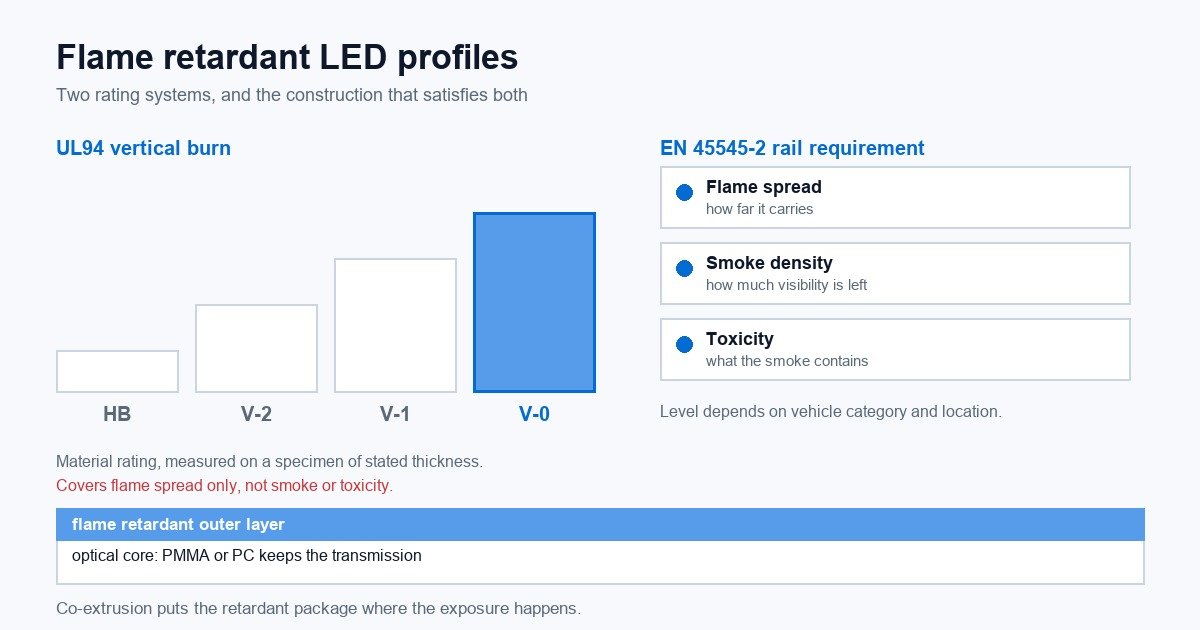
UL94 is a flammability standard for plastic materials. For extruded lighting profiles the relevant part is the vertical burn test, which rates how a small specimen behaves when a flame is applied and then removed. The grades run HB, then V-2, V-1 and V-0, with V-0 being the most demanding of the commonly quoted four. There are also 5VA and 5VB grades for harsher exposure, but you will not often see them on a lighting profile quotation.
Two things are worth understanding before you write V-0 into a drawing.
First, UL94 is a material rating, not a product rating. It is measured on a moulded specimen of a specific thickness from a specific compound. A profile extruded from that compound at a different wall thickness, or with a co-extruded layer, or with a texture rolled into the surface, is a different article with a different surface-to-volume ratio. The rating on the compound data sheet is evidence about the material, not a certificate for your finished section.
Second, V-0 says nothing about smoke or toxicity. A material can stop burning quickly and still produce dense or toxic smoke, and in an enclosed vehicle it is the smoke that decides how much time people have. This is the single most common gap between what a supplier offers and what a rolling stock project actually requires.
So: ask for V-0 by all means, but ask which compound it was measured on, at what thickness, and ask separately about smoke.
EN 45545-2: the European rail framework in plain terms
EN 45545-2 is the European standard covering fire protection of railway vehicles, and the part that matters here is the one governing materials and components. Its structure is worth knowing even if you never read the standard itself, because it explains why suppliers quote in ranges rather than in single numbers.
The standard sorts vehicles into operation categories, roughly by how easy it is to evacuate them (an underground metro with long tunnels sits at the demanding end, an open main line vehicle at the other). It then assigns every component a risk level based on where it is in the vehicle and how much of it there is. A small lighting diffuser high in a saloon and a large continuous lens running the length of a corridor will not carry the same level.
For each level the standard sets requirements across three behaviours: flame spread, smoke density and toxicity. Lighting profiles are usually asked to meet a defined level across all three, which is exactly why a UL94 V-0 certificate alone does not close the conversation.
What you can do with this as a buyer is quite specific. Tell the supplier the operation category and the component location, and ask them to state which risk level they are offering against. If they can only say “flame retardant”, they have not read your requirement. If they name a level and send a report that carries it, you have something you can check.
Where flame retardance fights the optics
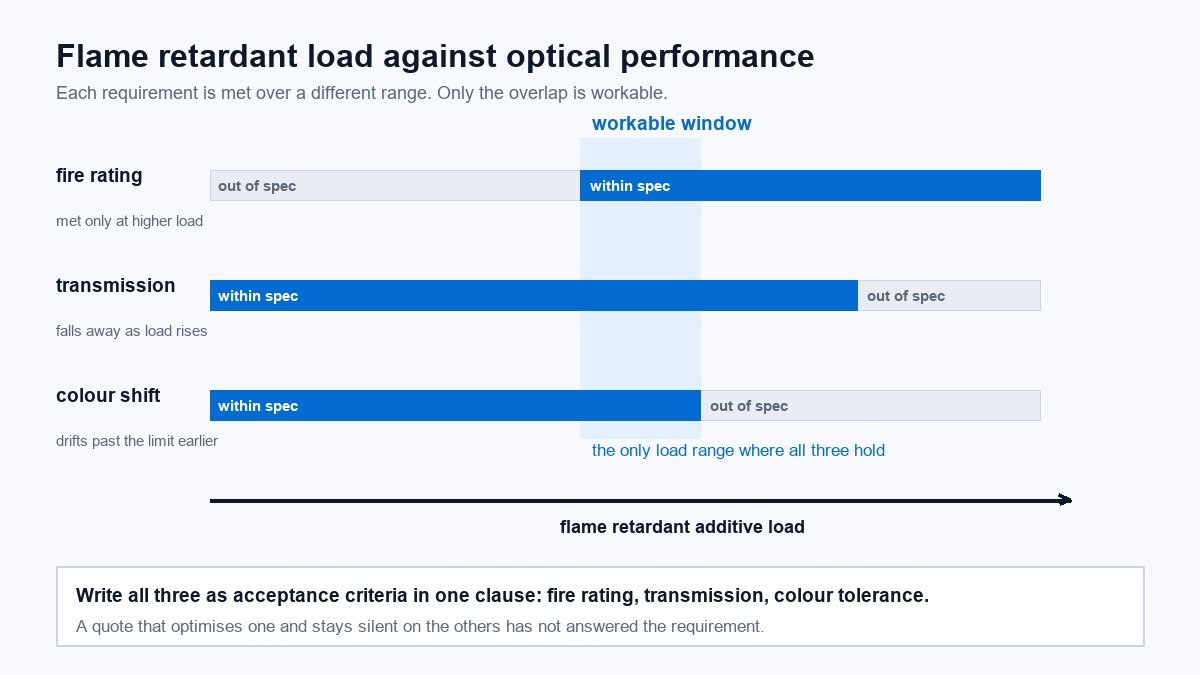
Flame retardant packages are additives. They sit in the polymer alongside everything else, and they interact with light.
In a diffuser the effect shows up as a loss of transmission and, more annoyingly, as a shift in colour. A compound that holds V-0 may transmit a few points less than the optical grade it replaced, and it may sit slightly warmer or greener in tint. On a datasheet that looks minor. On a long saloon run where twenty luminaires are visible at once, a half-step of tint shift between the diffuser and the surrounding trim is visible to passengers, and it is the kind of detail that gets a batch rejected.
There is also a processing consequence. Flame retardant compounds can be more sensitive to melt temperature and residence time, and degradation from running too hot shows up first as colour. That is a process control question, which means the answer is partly in how the line is monitored rather than in which compound is chosen.
The useful move is to refuse the trade-off as phrased. Do not ask for “flame retardant and high transmission”. Ask for a transmission figure, a colour coordinate tolerance, and a fire rating, in the same line of the specification, and make clear that all three are acceptance criteria together. The same rule applies to any custom diffuser profile where the optical target is the point of the part. A supplier can then quote a compound that balances them instead of optimising one and hoping you do not measure the other.
Material choice: PC, PMMA and the additive trade-off
Polycarbonate and PMMA start from different places on fire behaviour, and that difference is worth using rather than fighting.
Polycarbonate has inherently better fire performance than PMMA and reaches demanding vertical burn ratings more readily. It also carries the impact resistance that transit interiors want, since a saloon light is within reach of luggage, cleaning equipment and vandalism. Its weaknesses are elsewhere: it yellows faster under UV, it is more notch sensitive, and it costs more per kilo.
PMMA transmits light beautifully and holds its colour well outdoors, but it burns more readily and getting it to a demanding rating typically means a heavier additive load, which is where the optical penalty grows.
So the usual outcome is that PC carries the fire responsibility and PMMA carries the optical one. Where a project needs both, the answer is not to compromise on a single material but to put them in different layers of the same profile. The PC versus PMMA comparison covers the property spread behind that split in more detail.
Co-extrusion as a way out of the trade-off
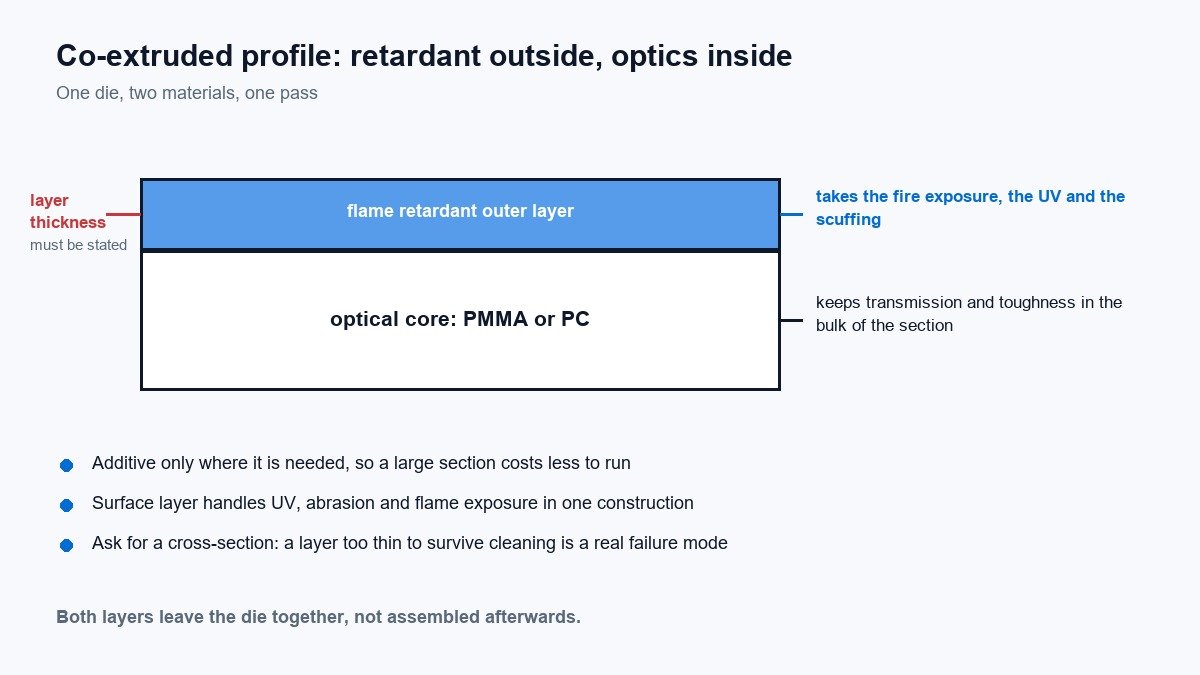
Co-extrusion runs two materials through one die so the profile comes out as a single section with distinct layers. On a co-extrusion platform the combinations are not limited to decorative two-colour work: a functional layer can carry UV resistance, wear resistance or flame retardance while the core keeps the optical and mechanical properties you actually specified.
For a transit project the useful construction is a flame retardant outer surface over an optical core. The fire exposure happens at the surface, so that is where the retardant package needs to be, and the bulk of the section keeps the transmission and the toughness of the base polymer.
This has a second benefit worth noting on the commercial side. Putting the expensive additive only where it is needed costs less than running it through the whole section, which matters when the profile is a large one and the run is long.
Our equipment pages note co-extrusion capability for dual layer and dual colour work, with flame retardance to V-0 among the properties it is used to deliver, alongside UV resistance and abrasion resistance. As with any capability claim, ask which constructions have actually been run and for how long, rather than accepting the platform description on its own.
Seven clauses for the specification
- Name the standard and the grade. “Flame retardant” is not a specification. UL94 V-0, or the relevant EN 45545-2 level, is.
- State the wall thickness the rating applies to. A rating measured on a 3 mm specimen does not automatically carry to a 1.5 mm wall.
- Ask for smoke and toxicity separately from flame spread, especially for any enclosed vehicle interior.
- Put the optical target in the same clause as the fire target. Transmission, haze and colour tolerance stay as acceptance criteria even on a flame retardant grade.
- Say whether the rating applies to the whole section or a co-extruded layer, and describe the layer if so.
- Require the test report with the delivery, not with the quote, and require it to name the compound actually extruded.
- Tie the report to a batch number. A report you cannot trace to the material in your shipment tells you about the supplier’s filing system, not about your goods. The lot number and inspection record structure that makes this work is the same one that supports a colour complaint six months later.
What to ask the supplier to show you
Three documents, in this order of usefulness.
A test report from a named laboratory, dated, showing the compound, the specimen thickness and the grade achieved. If the compound on the report is not the compound in your quotation, the report is decoration.
A declaration covering smoke density and toxicity for the same compound, because this is the part most often missing and the part a rail integrator will ask you for first.
A construction drawing or sample cross-section if co-extrusion is involved, showing which layer carries the flame retardant package and how thick that layer is. A surface layer that is too thin to survive scuffing and cleaning is a real failure mode, and it is easy to spot on a cross-section long before it becomes a problem in service. For the documents we hold, and the two things they do not cover, see the certificates and compliance page.
Finally, ask what happens on a re-order six months later. Flame retardant compounds are more prone to lot-to-lot variation in tint than optical grades, and a project with a continuous saloon run cannot accept a visible step between the first delivery and the second. That is a question about records as much as chemistry, and it is worth asking before the first order rather than after the second.
Where this leaves the enquiry
The fire requirement is not an obstacle if it arrives early. What causes trouble is a quote built on optical performance alone, followed by a fire specification added after tooling has started, because by then the compound choice is constrained and the re-test cost lands on someone.
Send the fire requirement with the drawing. Say which standard, which level, and whether smoke is in scope. Then check that the optical numbers did not quietly disappear from the quote when the flame retardant grade appeared. If you are also sealing the fixture, the IP rating clauses belong in the same document rather than in a later revision.
If you have a project at this stage, send the drawing and the fire requirement together and the quote comes back against the real constraint instead of being rebuilt later.
How to read a UL 94 yellow card before you accept it
A yellow card is a material rating, not a certificate for the luminaire. That distinction is the whole point: the card tells you how a specific resin of a specific colour, at a specific thickness, behaved in a specific test. It says nothing about the finished fixture, and nothing about a different wall thickness. Reading it properly is a five-field exercise.
| Field on the card | What to check | Why it decides the answer |
|---|---|---|
| Material designation | The exact grade, including the suffix. Suffixes separate flame-retardant, UV-stabilised and optical variants of the same base resin. | Two grades of one resin can carry different flame classes. “Polycarbonate” is not a specification. |
| Colour | Whether the rating covers the colour you are buying — clear, and whether opaque colours are listed separately. | Flame performance can be colour-dependent; a rating on natural resin does not automatically transfer to a pigmented one. |
| Thickness tested | The minimum thickness at which the class is achieved, and whether your wall is above it. | The single most commonly missed field. A V-0 rating achieved at 1.0 mm does not describe a 0.6 mm wall. |
| Flame class | V-0, V-1, V-2, or 5VA/5VB — and the test method behind it. | The class is only meaningful together with the thickness at which it was achieved. |
| Card holder | Who holds the card and whether it is current. | A resin maker’s card is not a supplier’s certification. Ask which document covers the profile you are actually buying. |
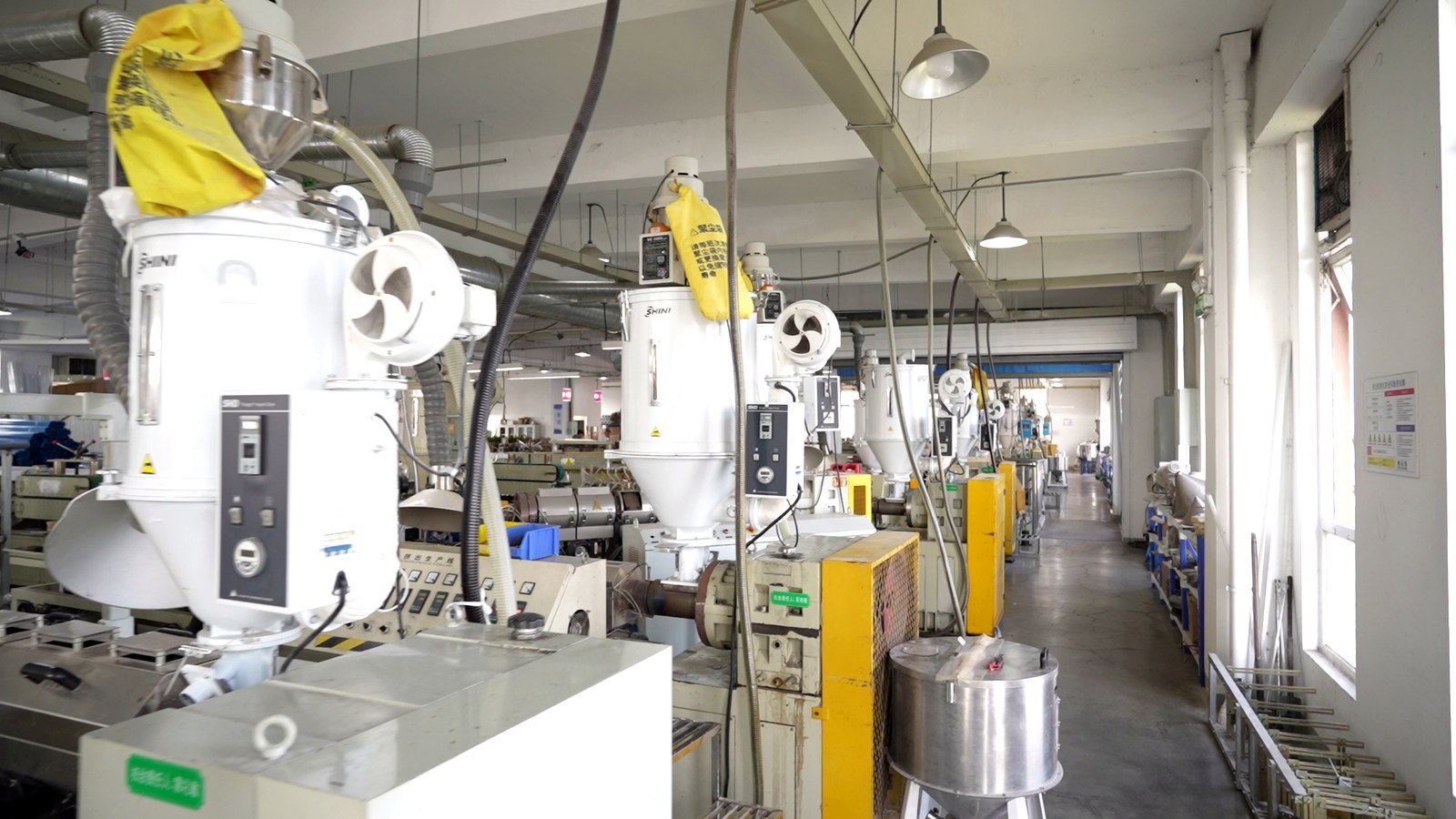
Four ways a flame-retardant requirement is written badly
What to put on the drawing
- Required flame class and the standard it is measured against — V-0, V-2, or the product standard your market actually applies.
- Minimum wall thickness anywhere in the section, not the nominal. The thickness is what the rating hangs on.
- Colour, and a request for the yellow card that covers that colour.
- Whether the card must be supplied with the batch, and in whose name it is held.
- Any transport or rail-specific requirement, stated as the standard and its version, not as a phrase.
Related reading: polycarbonate material notes, the PC vs PMMA selection matrix, and certificates and compliance documents.