Custom Extruded Lens vs Secondary Optics: When Each Wins
Abstract: An extruded lens is a two-dimensional section with one optical axis, repeated along the whole length. A secondary optic is a three-dimensional part placed at a discrete position. That single difference decides most of the choice: extruded suits linear fixtures with constant cross-section, secondary optics suit point sources and asymmetric distributions. This page sets out where each one actually wins, the three cases where an extruded lens cannot deliver the photometry, and how to combine the two in one fixture without paying twice.
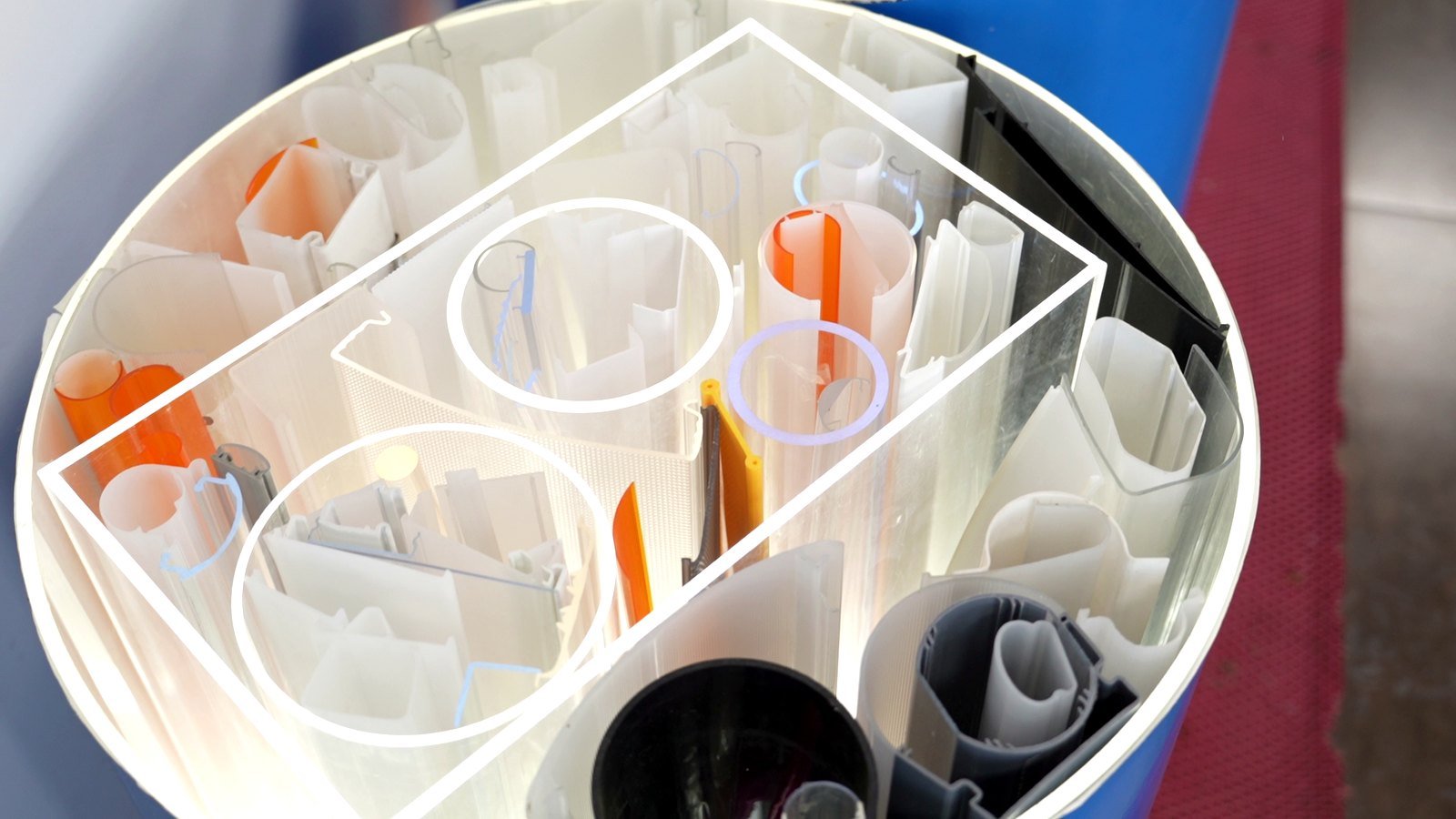
The structural difference, in one paragraph
An extruded lens is pulled through a die. Whatever the section is at one point, it is at every point along the length. That means the beam it produces is also constant: if the section steers light 30° to one side, it steers it 30° to that side for ten metres. A secondary optic is moulded or cast into a three-dimensional shape and bonded or clipped over an individual LED, so its distribution can vary from one emitter to the next — and can be asymmetric in both axes.
Everything below follows from that.
Where an extruded lens wins
| Situation | Why extrusion fits |
|---|---|
| Linear luminaires with constant cross-section | The fixture is already a prism. The lens is one more prism in the stack, cut to the same length as the housing. |
| Continuous runs and coves | There are no seams to align, no individual optics to place, and no visible pattern where one module meets the next. |
| High-volume standard lengths | One die serves every length. Cost per metre falls with volume in a way that moulded optics cannot match, because there is no per-part cost. |
| Fixtures where the LED pitch must be hidden | An asymmetric prism section can spread each emitter’s image along the run, so the pitch disappears without extra diffuser film. |
| Projects that need a bespoke beam but not a bespoke mould | A section change is a die change, not a new mould. That is a shorter and cheaper route to a non-catalogue distribution. |
Where a secondary optic wins
- Point sources. Downlights, spots, high bays and track heads have no length to extrude along. The optic has to be a body of revolution or an asymmetric freeform.
- Two-axis control. An extruded section can tilt a beam sideways, but it cannot squeeze it in the along-run direction at the same time. If you need a rectangular or batwing distribution from a linear fixture, the shaping has to happen per emitter.
- Sharp cut-off. A TIR optic can produce a hard cut-off that a prism section cannot. If the specification is a cut-off angle rather than a distribution curve, that is usually the signal.
- Mixed emitter spacing. When spacing varies along the run — for example at the ends of a module — a constant section treats every emitter the same, which is wrong for the ones near the end.
The three cases where an extruded lens cannot deliver
It is worth being blunt about this, because these are the projects that go wrong late.
1 · Asymmetry in both axes
A wall-washer that needs a narrow beam across the run and a wide spread along it is asking for two different profiles at once. A section can only do one.
2 · A hard photometric cut-off
Prism sections produce gradual transitions. If the brief includes a defined cut-off angle measured on a goniometer, a refractive section will not meet it.
3 · Per-emitter aiming
If different emitters in the same fixture must point in different directions — retail accenting, for instance — the optic has to move per emitter, and a section cannot move.
Combining both without paying twice
The two are not exclusive, and the most efficient linear fixtures use each where it is strong: an extruded diffuser or lens as the outer element that handles the run, and a small secondary optic only where the distribution actually needs one. Two rules keep that arrangement from doubling cost:
- Decide which element owns the beam. If the extruded section already shapes the distribution, the secondary optic should be doing something else — glare control, colour mixing — not re-shaping what is already shaped.
- Do not stack two diffusers. An opal secondary optic behind a prismatic extruded cover loses more light than either element alone would, and the loss is multiplicative, not additive.
What to put on the drawing
If the answer is an extruded lens, the drawing needs four things beyond the outline:
- The optical intent in words. “Spread the emitter image along the run so pitch is invisible at 300 mm viewing distance” is a specification. “Prismatic” is not.
- The marked critical dimensions — the ones that set the optical path, usually wall thickness over the prism and the prism pitch.
- Material and transmission target. Clear PMMA and opal PC sit at opposite ends of what a section can do. We work from 0–97% transmission depending on material and surface.
- The mating surfaces. How the lens seats into the housing decides whether the optical path is what the drawing says it is.
Frequently asked questions
Can an extruded lens replace a TIR optic?
For a linear fixture with a constant distribution requirement, often yes — a prism section can shape the beam and hide the emitter pitch at the same time. It cannot reproduce a hard cut-off or two-axis asymmetry. If the photometric file has a sharp cut-off, keep the TIR.
How tight can the prism geometry be held?
We work to ±0.1 mm on marked critical die dimensions, and prism features are treated as critical when the optical target depends on them. The practical limit is not the die but the measurement: prism pitch and apex angle need optical inspection, not calipers, and that has to be agreed before the first article.
Is an extruded lens cheaper than a moulded secondary optic?
At volume, per metre it usually is, because there is no per-part cost — one die serves every length. At low volume the tooling line dominates and the comparison flips. The crossover depends on section complexity, so it is worth pricing both before committing to a mould.
Can you co-extrude a lens and a diffuser in one section?
Yes — a clear or lens-carrying strip alongside an opal strip in the same profile is a normal co-extrusion. It is how fixtures get a controlled beam in one zone and glare control in another without adding a second part.
Next step
Send the section and the optical intent in words, and we will tell you whether a section can meet it or whether the project needs a secondary optic. Request a quote, or see custom LED lenses and optical lighting profiles for the range we extrude.